
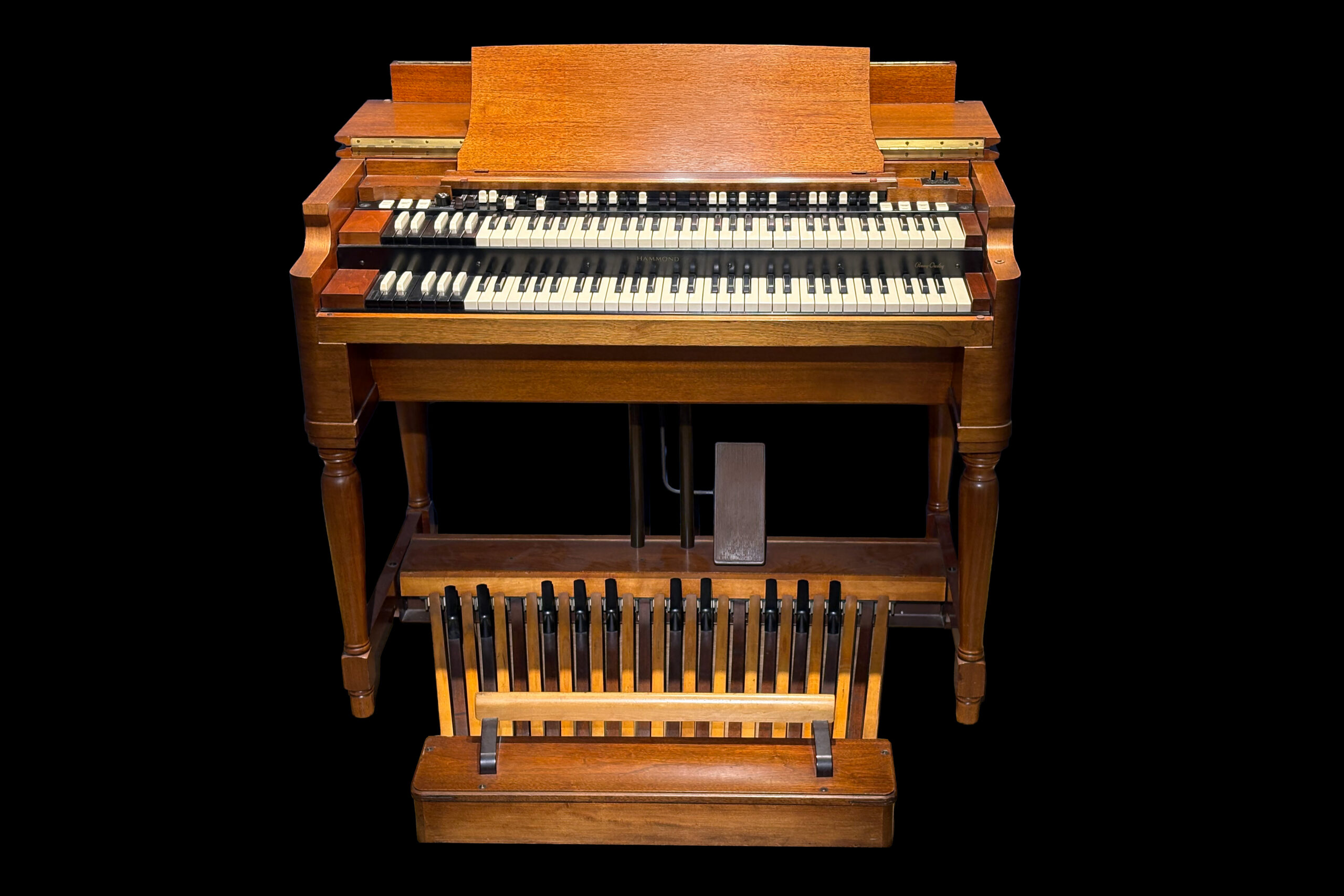
The Hammond Organ Company introduced the Model B-3 in 1954 and produced it continuously until 1974. Its distinctive “B” cabinet design, first introduced in 1936, provided the foundation for a series of increasingly sophisticated instruments. The B-3 is especially notable for its “harmonic percussion,” a feature that adds a sharp, percussive edge to its sound.
Originally designed as a more affordable alternative to pipe organs for churches, the B-3 quickly found a life far beyond its intended purpose. Some traditionalists dismissed it as an imitation, but musicians heard something different. In places like Chicago, players began pushing the instrument to its limits, discovering a sound that could growl, shimmer, and sing in ways no pipe organ could. Paired with a rotating speaker, it developed a rich, expressive voice that moved easily from church to nightclub, becoming a defining sound in jazz, gospel, and rock.
Though discontinued in 1974, the B-3 remains the most popular Hammond organ and continues to be widely emulated in digital instruments.