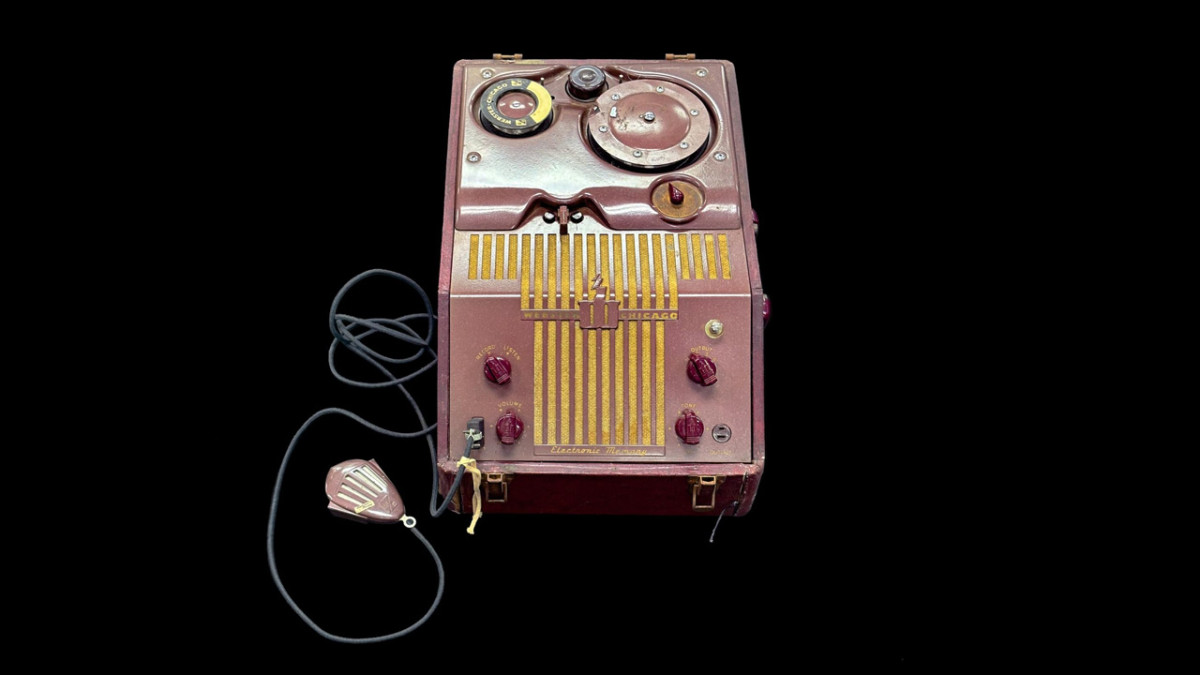
Webster-Chicago “Electronic Memory” Model 228-1
This month, we highlight the Webster-Chicago “Electronic Memory” Model 228-1 portable wire recorder.
You might be wondering why a wire recorder is featured at the Museum of Making Music. While not originally intended specifically for music, the wire recorder represents an important step in the evolution of audio technology that ultimately made modern music recording possible.
In the late nineteenth century, sound recording was entirely mechanical. Thomas Edison’s phonograph, for example, used a stylus to inscribe sound vibrations onto a physical surface, allowing for both recording and playback. This basic method persisted into the early twentieth century: sound waves were captured and etched onto wax-coated discs as a stylus moved gradually inward across the surface. Later advancements allowed microphones to capture sound, significantly improving audio quality.
The magnetic wire recorder, such as the “Electronic Memory,” marked an important transition from mechanical to modern recording. Although wire recording dates to the late nineteenth century, it became most widely used between the 1940s and 1960s for office dictation and, to a lesser extent, home entertainment. Its major innovation was the ability to convert sound into a magnetic signal that could be erased and reused, a feature especially valuable during World War II. It also enabled longer recording times, making it useful for oral histories.
Magnetic wire recording served as a precursor to magnetic tape recorders, developed in the 1930s and widely adopted in the late 1950s. Audio engineer John T. Mullin played a significant role in advancing tape recording in the United States, particularly through its use in motion picture sound and its introduction to performer Bing Crosby, who helped bring it into mainstream broadcasting and entertainment. Magnetic tape also enabled the development of multitrack recording, in which separate audio elements could be recorded and combined. This innovation led to stereophonic (stereo) sound and expanded creative possibilities in both studio production and broadcasting. Guitarist and inventor Les Paul was among the early users experimenting with these techniques, helping to shape modern recording practices.
By the 1970s, digital recording technologies began to emerge, offering greater flexibility, precision, and ease of use. Today, recording tools are more accessible than ever, available on devices ranging from smartphones to professional studio systems.
The evolution of recording technology has been fundamental to the development of music as both an art form and an industry. By enabling sound to be captured, preserved, and shared, these innovations transformed music from a purely live experience into a permanent and widely accessible art form.